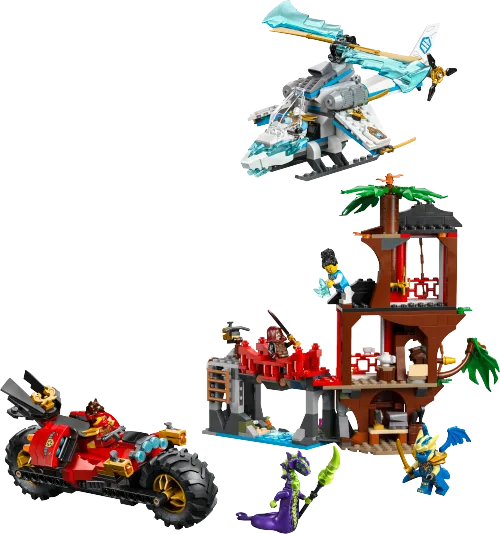
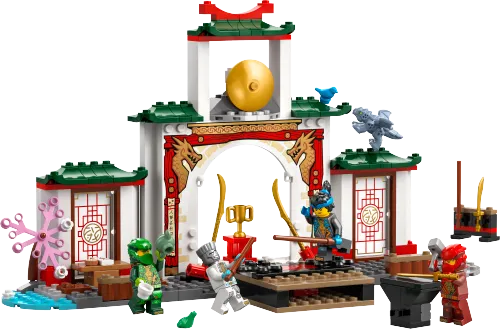
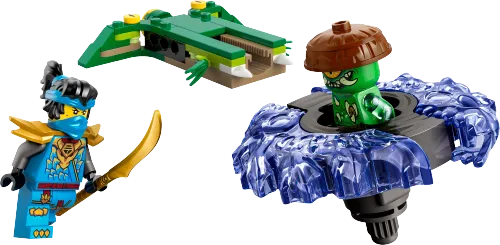
Ninjago is the LEGO theme where retirements are easiest to read — if you know what you are looking at. You do not need a crystal ball: the range moves to the rhythm of the show’s seasons, and when several sets share an exit date, it is not a coincidence, it is an end of season. Right now our database shows exactly that: a complete batch dated 31 July 2026. This guide explains how the cycle works, what leaves in this wave and how to buy well for the fan at home — who in Ninjago is usually between 7 and 12 years old and has very clear ideas.
The Ninjago cycle: seasons, not whims
Each arc of the show brings its generation of sets: the main characters’ mechs, the arc’s dragons, the flagship vehicle and the central temple or location. When the arc ends and the next one starts, the outgoing generation is retired as a block to make room — and its specific characters, in that season’s outfits, are never made again.
This has two consequences that set Ninjago apart from an evergreen theme like City. The first: the replacement exists but is not equivalent — there will be another Lloyd dragon next season, but it will be another dragon, from another arc, with another design. For an adult it is a nuance; for the child who wants that dragon from that season they are watching, it is the whole difference. The second: old Ninjago batches hold up surprisingly well in demand — the flagship mechs and dragons of past seasons are among the most sought-after items on the children’s secondary market, and LEGO confirms it indirectly every time it launches Legacy reissues of the classics.
The 31 July wave
What leaves in this batch, according to the official range:
- Temple Bounty (71848) — 2,387 pieces. The ninjas’ ship is the permanent icon of the theme (every generation has its version) and this is the big version of the current generation. It is the display set of the batch and the one that will be missed most.
- Lloyd’s Reactor Mech (71845) — 1,112 pieces, the flagship mech of this arc’s main character. Lloyd’s mechs have historically been the most in-demand in the theme.
- Chaos Dragon: Thunderfang (71832) and the Master Dragon Rontu (71842) — the arc’s dragons, in medium and compact size.
- Rogue’s Mech and Dragon (71843) and the Ninja Combat Vehicle (71844) — the mid tier of action.
The picture is textbook and needs no creative interpretation — it is the close of a generation just as the range publishes it: temple/ship + main character’s mech + dragons + vehicles, all with the same date. A by-the-book end of season, of the kind that repeats with every arc in this theme — and that, once you learn to spot it, makes Ninjago retirements the most predictable and manageable in the whole LEGO range.
Buying well for a Ninjago fan (a guide for parents)
Ask first which season they like, before the budget and before the size. It seems obvious and it is mistake number one. Ninjago has had more than a decade of different arcs, and the child hooked on the current arc wants the sets of the current arc — the ones in the July batch. The “lookalike” from next season does not count: the outfits, the dragons and the villains change.
If their top pick is in the batch, July is the month. This is one of the few children’s purchases where getting ahead of the retirement makes real sense (we said it in the theme guide and we stand by it): the November birthday present that depends on a set retired in July will be bought at a high price, second-hand or badly.
The order if you have to choose: the mech or dragon of their best-loved character first (it is what the child sees as “theirs”), the Bounty next if the budget stretches (it is the set that outlives the season as the heart of play), and the medium vehicles last (they are the ones least mourned).
The Bounty, a separate case for adults. If the buyer is you and you grew up with Ninjago, this generation’s ship is the theme’s display purchase — 2,400 pieces of icon with a date written on it. The usual applies: current price against official on the page, and a decision this month, not in the autumn.
How to tell which season a set is from (the two-minute trick)
The practical obstacle for the non-fan parent: Ninjago boxes do not shout “SEASON 2024” anywhere, and in shops the range mixes leftovers from several waves. Three clues that work without being an expert. First, the character’s outfit on the box: show the box to the child or compare it with what they see in the show — the outfits change every arc and the fan tells them apart instantly, even if you cannot. Second, the set number: those in the same batch have consecutive numbers (look at the 71832-71848 of this wave); if the set you are looking at falls in that range, it is from the current arc. Third and definitive, our page: each set shows its retirement date if it has one — a set from the current arc with a July date tells you everything you need about the calendar.
And the reverse trick, for bargains: a Ninjago set with a big discount in a physical shop is usually a leftover from the previous season. For an adult collector it can be a smart buy; for the child living in the current arc, it is the “wrong” dragon even if it is objectively a better set. The gift rule in this theme is emotional, not technical: the right season matters more than the pieces.
What you do NOT need to chase
Some balance, since this house does not sell urgency: the small action sets (the ones with one character and a motorbike or compact vehicle) rotate every season and there will always be a new functional equivalent — chasing them once retired at a markup makes no sense for a child’s real play. The training packs and spinners are consumables of the range: each arc brings its own. And the Legacy reissues, when they exist, fill the emotional gap of the classics at the regular price — before paying double on the secondary market for an old mech, check whether LEGO has already reissued it.
Each set’s page — captured Amazon price against the LEGO.com official one, with the date visible — is the referee for all of the above. In such a children’s theme, third-party markups at the end of the batch are especially common because parents buy in a hurry and without comparing: the minute spent checking the page is the best-paid minute of the month.
In short
Ninjago is read in batches: the 31 July one is a complete end of season, with the Temple Bounty and Lloyd’s mech as the major pieces. If there is a fan of the current arc in your home, decide this month with the page in front of you; if not, let the wave pass without anxiety — next season will bring its own fleet of dragons, and the calendar and the advisor will be here to read it with you. The dates cited are those of the official range at the time of writing; if LEGO moves them, the pages take precedence.