The conversation about display LEGO has been hijacked by the huge sets: ships 1.5 m long, buildings of four thousand pieces, castles that need a table of their own. And meanwhile, most people live in homes where the available display space is half a shelf in the living room. This guide is about that: collecting LEGO to display when space is the scarcest budget, which is the real situation for almost everyone.
The good news is that LEGO has spent years quietly building three lines designed exactly for this buyer. All three share virtues — contained format, the look of an object rather than a toy, a price under 80€ — and each one fills a different gap in the house. All three have their own collection on the site, with a live list and dates; here is the decision layer.
The wall: postcards (13-15€)
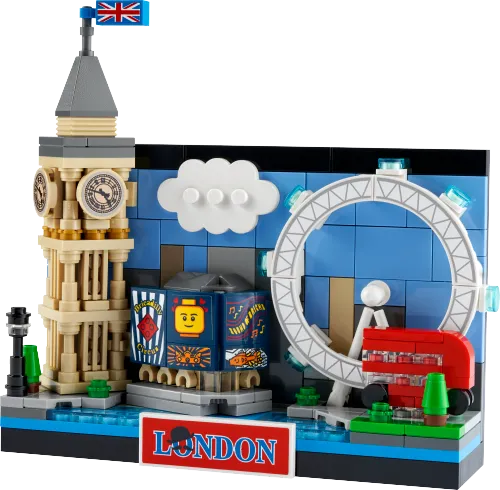
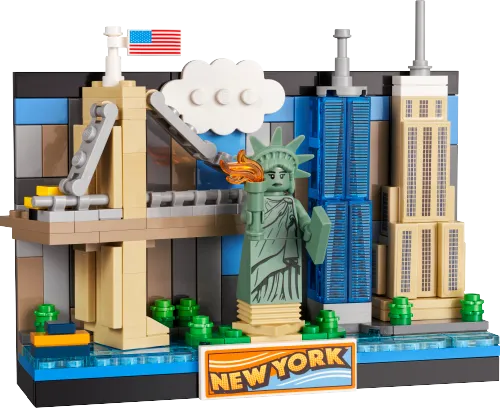
The smallest and cheapest format in the whole display range is the postcards: flat pictures with a city skyline that you build in an afternoon and that take up zero horizontal surface, because they hang or lean like a photo frame. As of this update there are five live ones on sale — London (40569, 277 pieces), Japan (40713, 262), New York (40519, 253), Germany (40954, 240) and Italy (40818, 189) — at 14.99€ official price. The London one, with 277 pieces for 14.99€ (18.5 pieces per euro), is the best pieces-per-euro figure on LEGO’s entire list (you can check it in the live ranking, where the postcards take the top spots).
For anyone starting a display collection in a small home, the postcard is the perfect opening move: fifteen euros, zero risk, and you find out whether you like displayed LEGO before committing money or shelf space. The trick that lifts them, and that we repeat in the Secret Santa guide because there it is deadly: choosing the city with a personal meaning — where they lived, where they got married, the trip still pending. Relaxed availability, for a change: four of the five live ones have a date of 31 December 2027, and the Germany one runs to 31 December 2028 — one of the few corners of LEGO’s list where there is no need to rush.
The bookshelf: helmets (65-80€)
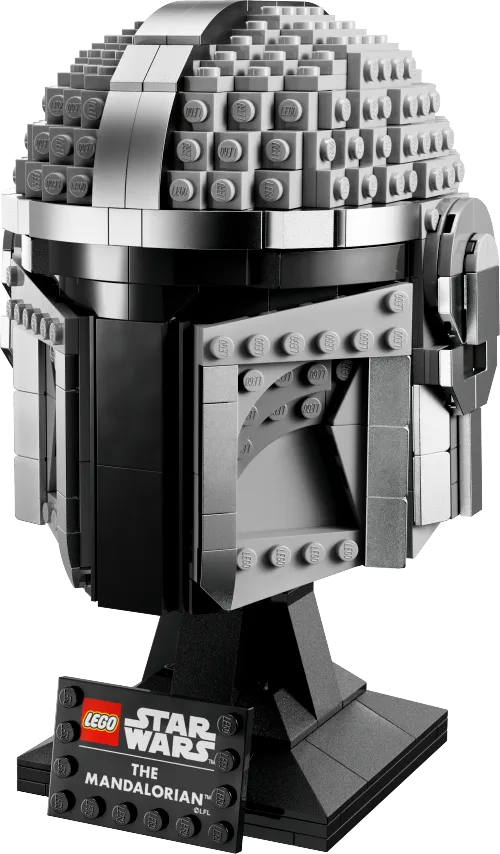
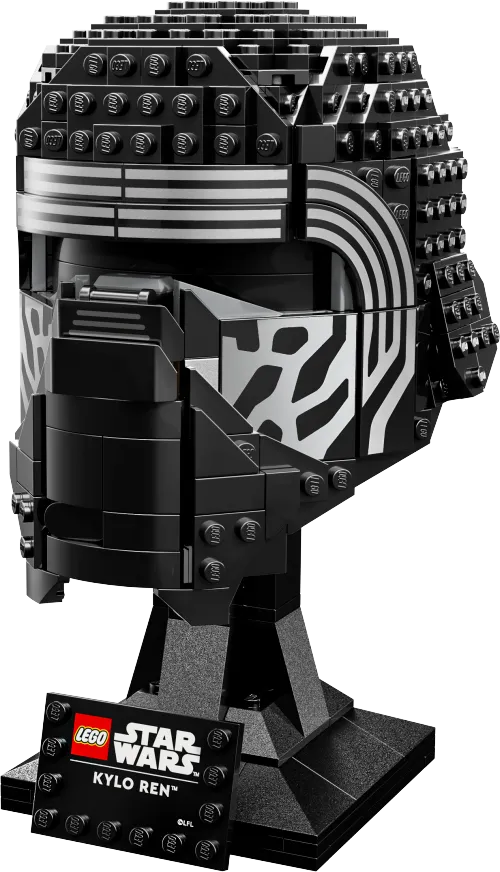
One step up in price and presence are the Star Wars helmets — the Helmet Collection: helmet busts at reduced scale, from 529 pieces (Kylo Ren) to 854 (Captain Rex), with a stand and nameplate, at 69.99-79.99€ official price. It is the format with the best presence-to-space ratio LEGO has ever invented: a helmet takes up as much room as a thick book standing upright, and from the other side of the room you can clearly read what it is. They are built in two evenings and the collection effect is immediate — two helmets together already look like a curated display case, not a stray toy.
Their fine print is rotation: the line works like a yearly series, with helmets coming in and helmets going out, and shelf lives shorter than those of the big sets. The live lineup, with official dates as of this update: the Captain Rex Helmet (75349, 854 pieces, 69.99€) leaves on 31 July 2026 — weeks away —; three close at the same time on 31 December 2026: The Mandalorian (75328, 584 pieces, 69.99€), Kylo Ren (75415, 529 pieces) and the AT-AT Driver (75429, 730 pieces, 79.99€); and Jango Fett (75408, July) and the AT-RT Pilot (75458, December) have breathing room until 2027. With helmets, the discipline is to look at the date before the discount; the collection list sorts them by urgency precisely for that reason.
The star shelf: dioramas (60-100€)
The third format is the newest and the most “museum-like”: the dioramas, framed movie scenes on a black base with a quote from the film on a plaque. Where the helmet displays an object, the diorama displays a moment — the podrace, the ship’s corridor — and that storytelling makes it the conversation piece of the house. It is still a contained format (the base sets the size and it is contained), but it asks to be seen head-on: it wants a shelf at eye level, not a high corner.
As a purchase they share the helmets’ logic — 60-100€ official price, a weekend build, series rotation — with a warning that almost nobody gives and that our radar can: as of this update the Diorama Collection is between waves — zero live dioramas on LEGO’s official list. The latest ones (the podrace, the Tantive IV corridor) left with a date of 31 December 2025; what you see in stores today is leftover stock, and the scenes are not re-released: when that stock runs out, that composition moves to the secondary market. In practical terms: if you find one at the official price, it is one of the few times when “buy it now” is literal; if not, the diorama spot in your display case waits for the next wave — the collection updates itself the day LEGO announces it. The ideal buyer is still the declared fan who has already been given their character’s helmet: the diorama of their scene is the next level of the same language.
How this comes together in a real home
Our recipe for a complete display in under 1 m of shelf plus a piece of wall, with the sum done on live official prices: a postcard on the wall (14.99€, the city with a personal story), a helmet standing up (69.99€, the character closest to your heart) and the third spot for the diorama of your scene when the line comes back on sale (~100€ based on the series’ history) — or, in the meantime, a second helmet (the AT-AT Driver, 79.99€, brings the total to 164.97€). With the diorama included you will be around 185€: under 200€ in either of the two versions. Three formats, three visual heights, zero toy-store feeling — and each piece is built in less than a weekend, which also matters in small homes: no dining table hijacked for three weeks.
The buying order? The one the dates dictate, not taste. Of the three formats, postcards have plenty of time left, and helmets and dioramas rotate fast: if your candidate appears in its collection with an announced date, that one goes first. It is the rule for the whole house — we explain it in detail here — applied to the most rewarding corner of LEGO’s list.
Upkeep: the three enemies of displayed LEGO
Collecting to display has a running cost that nobody warns you about on the box, so we will. Enemy number one is dust: a set displayed without protection needs a once-over every few weeks, and the right tool is not a cloth (it drags and knocks pieces loose) but a soft makeup brush or an air blower of the kind used to clean cameras — two euros in any discount store and they work better than any gadget. The three formats in this guide have another hidden advantage here: small, mostly smooth surfaces, minutes of cleaning where a modular takes an afternoon.
Enemy number two is the sun. ABS plastic turns yellow under direct ultraviolet light, and it does so slowly, unevenly and irreversibly — the window side first. The rule: never sustained direct exposure; the perfect shelf is on the wall perpendicular to the window, with ambient light but no rays falling on it. Postcards, being on the wall, are usually protected by default; with helmets and dioramas it is worth thinking about when choosing the spot.
The third is other people’s gravity: cats, kids and curious visitors. If your house has any of the three, cheap screw-together display cases (the ones from collector fairs or the classic glass-door cabinet from the Swedish furniture store) turn any shelf into a safe zone for 30-60€. For the compact format in this guide, a single small display case covers the entire collection — another bill that giant sets multiply and this approach does not.
What NOT to buy for small spaces
We close with the negative list, because this buyer’s mistake is always the same: falling for a big set “that will find a spot somehow”. It does not. A large-scale Technic is a piece of furniture; a giant of more than 3,000 pieces is a real-estate commitment; even a modular, with its 32×32 base, asks for a street, and the street asks for a sideboard. They are all great purchases for another house. If space is your constraint, the three formats in this guide are not the consolation prize — they are the right collection, chosen with your head, which also leaves money for the day the house grows.